Why a lightweight tarp shelter matters for dawn sea-cliff silhouette shots
There’s a particular magic to shooting silhouettes at dawn from sea-cliffs: the soft gradation of colour, the crisp horizon line, and the drama that a 70–200mm brings when you compress distance and isolate shapes. I’ve learned that staying comfortable and protected in those early hours—without hauling a full bivvy or heavy tent—lets me focus on composition and timing. A lightweight tarpaulin shelter, rigged well, gives shelter from spray, wind and the worst of the cold while keeping me low-profile and quick to strike when the light changes.
Core goals when packing
When I pack for these shoots I aim for three things: mobility, low visibility and quick-change readiness. I want to be able to hike a mile or two along cliffs with camera and tele on my shoulder, find a sheltered vantage, and be ready to shoot in five minutes. That shapes everything I take.
Packing list — what I bring (and why)
- Mirrorless body + 70–200mm lens — the lens is the star. I prefer a 70–200mm f/4 for balance between weight and reach; if you have a 70–200 f/2.8 you’ll get more low-light headroom but it’s heavier.
- Small, sturdy tripod — a carbon/travel tripod with a low profile. I use one that folds compact but locks solid for tele focal lengths (wind is the enemy).
- Remote or intervalometer — to avoid camera shake and to time exposures during peak light.
- Extra batteries and memory cards — cold mornings drain batteries faster; carry at least two spares in an inner pocket to keep them warm.
- Lightweight tarp (2–3m²) — a 2.8 x 2.8m silnylon or Dyneema-lite tarp is ideal: waterproof, light and packable. Choose neutral colours—olive, slate or dark grey—to stay unobtrusive.
- Guy lines and a handful of cordage — reflective or non-reflective, 2–3m lengths with tensioners.
- Stakes and/or small sand/rock anchors — for cliff edges you’ll often use rocks; pack a few small aluminium pegs for firmer ground.
- 2 collapsible trekking poles or lightweight carbon poles — they create the ridge/peak for the tarp without needing trees.
- Small bouldering-style webbing and carabiner — for clipping tarp corners to fixed points when available.
- Groundsheet or closed-cell foam pad — I use a small pad to sit on if the ground is damp.
- Headtorch with red mode — hands-free lighting is essential; red keeps night vision and disturbs wildlife less.
- Warm layers, waterproof shell, hat and gloves — early dawn on the coast is cold and damp; the shelter won’t fully block wind chill if it’s open to the sea.
- Small thermos with hot drink and a snack — keeps you focused and out on location longer.
- Binoculars or small spotting scope — useful for scanning for birds and shapes before committing to composition.
- Trash bag and trowel — leave no trace and be ready to pack out anything you bring in.
How I rig a tarp shelter on a sea-cliff
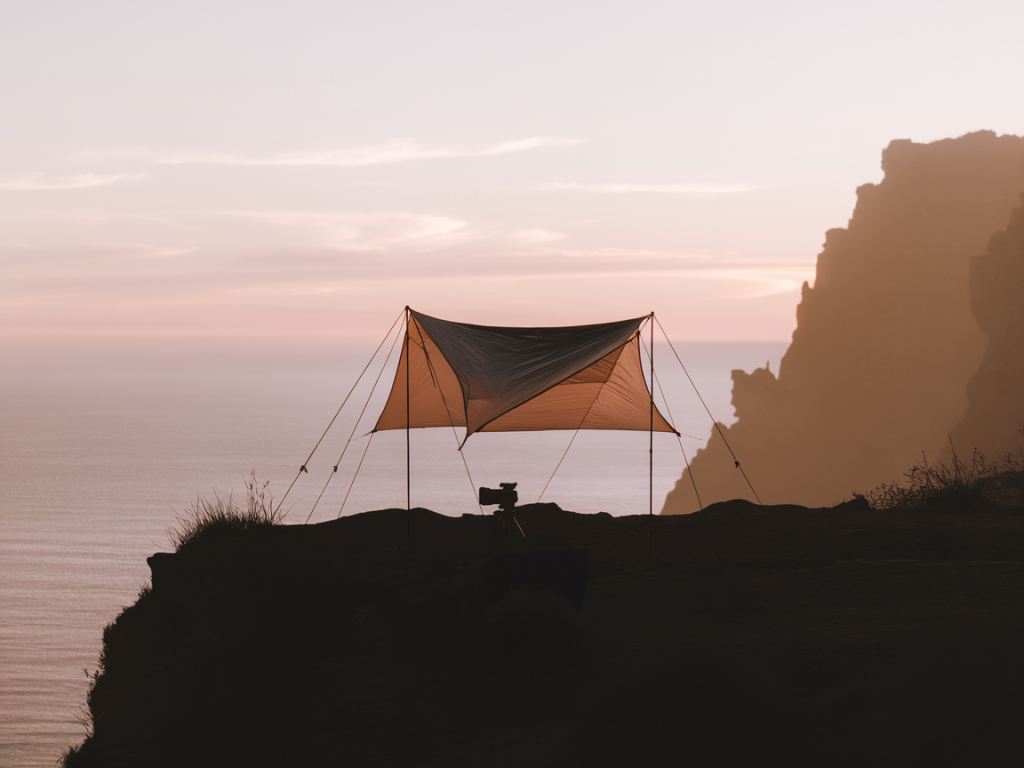
Cliffs rarely give you neat trees to anchor to, so the method needs to be flexible. I use trekking poles as the primary support and rocks/pegs as anchors. Below is my go-to pitch for a low, wind-sheltering hide that still allows a clear view over the cliff edge.
Pitch overview
- Low, angled lean-to facing the sea: one side raised slightly to allow shooting through the opening while the rear and windward sides are pegged low to cut wind.
- Use poles to form a ridgeline and create a sloping roof: this sheds spray and rain and keeps the front opening minimal—just enough to move the lens.
Step-by-step rigging
- Find a position with a stable footprint and a clear sightline. Place your tripod down and pre-frame a few compositions to test angles.
- Place two trekking poles roughly shoulder-width apart, positioned so the ridgeline will run parallel to your intended shooting axis. If the wind is onshore (from sea to land), face the opening away from the wind and slightly downwind.
- Drape the tarp over the poles so one ridge corner points seaward; adjust the poles' height to set the opening size—lower for more shelter, higher for easier shooting with the 70–200mm.
- Stake or clip the rear corners low to the ground, pulling tight to remove slack. If stakes aren’t possible, wedge corners under rocks or use a rock-sling to keep them secure.
- Guy out the front corners with tensioners so the opening holds a small, stiff lip—this prevents flapping and gives you a consistent shooting aperture.
- Use one side of the tarp pegged close to the ground to block wind and spray; the other side can be raised slightly for ventilation and to give your lens room.
- Inside the shelter, place your groundsheet and keep batteries warm against your body. Set the tripod so the head protrudes through the front opening or sits low behind it if you’re shooting handheld with IS/IBIS.
Composition and camera settings tips for silhouette shots
With a 70–200mm you’re compressing the scene. That helps isolate a lone rock stack, bird in flight or a distant fisher on the shoreline. I tend to think in simple, bold shapes for silhouettes.
- Meter for the sky — expose for the brightest part of the sky to render subjects as deep silhouettes.
- Use a smaller aperture — f/8–f/11 gives sharpness across the tele range and helps with diffraction control on mirrorless sensors.
- Shutter speed — if there’s movement (birds, waves) use 1/500s or faster to freeze; for smooth water try longer exposures with an ND filter and a very stable tripod.
- ISO — keep it low for best detail; use higher ISO only if you need to handhold fast action.
- Focus — single-point AF on the edge of the subject; when contrast is low, pre-focus on a marker and switch to manual.
- Bring an ND filter and a polariser — ND for long exposures at dawn, polariser to cut reflections and boost sky saturation when the sun is not directly in frame.
Safety and ethics on sea-cliffs
Sea-cliffs are dynamic and unforgiving. Always keep weight back from edges, avoid loose ground and be mindful of tides if accessing lower ledges. Don’t disturb nesting birds—use longer reach rather than approaching colonies. If you rig near a path, keep your shelter as unobtrusive as possible and pack away quickly if people need to pass.
Quick troubleshooting
If wind gusts are an issue, lower the front lip and add more ballast (rocks) to the rear corners. If spray is getting in, angle the tarp more steeply and use a secondary small piece of fabric or a pack cover to deflect. If condensation forms inside, vent the far side slightly to allow airflow—silnylon and Dyneema breathe enough with a small opening.
Minimal kit table (quick reference)
| Item | Why |
| Mirrorless + 70–200mm | Reach and compression for silhouettes |
| Small tripod | Stability for tele and long exposures |
| 2–3m tarp | Light shelter from wind/spray |
| Trekking poles | Instant ridgeline without trees |
| Guy lines & stakes | Secure shelter in gusts |
| Spare batteries | Cold-proof power |
| Headtorch | Hands-free prep in darkness |
Get to the spot early, set up quietly, and give yourself time to watch the light shift. The right shelter won’t just keep you dry—it will keep you focused, patient and ready for that one fleeting silhouette that makes the walk worthwhile.