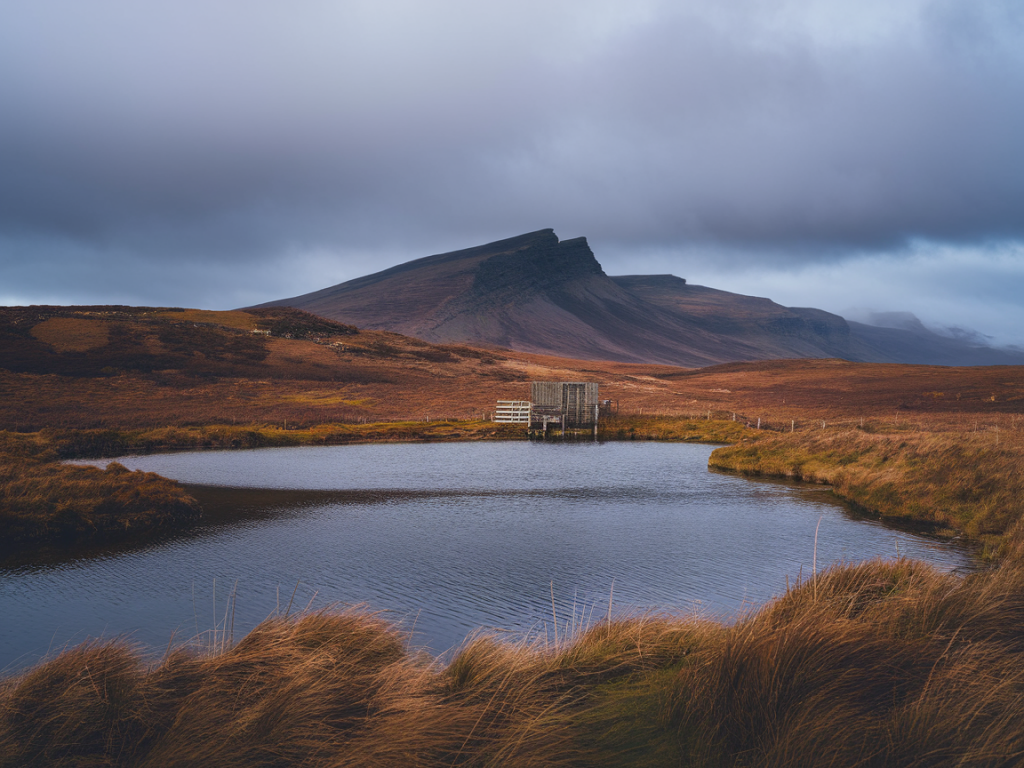
I spent several weekends recently walking moorland routes across northern England with the Sony a7C II in my pack, testing it as a handheld camera for landscape and wildlife shots. Moorland photography is a good stress test: wide, often windy vistas, tricky light that moves with cloud and sun, and the occasional fast-moving bird or wary mammal. I wanted to answer practical questions I ask before buying kit: how long will a battery last on a long walk? Can autofocus be trusted on distant sheep, red deer or flying skylarks? And does the in-body stabilisation actually let me handhold at slower shutter speeds without blur?
Why I chose the a7C II for these walks
I’ve been looking for a compact full-frame body that balances image quality, portability and real-world usability on long walks. The a7C II is attractive because it’s physically small compared to a typical full-frame mirrorless, offers a 33MP sensor that gives me plenty of crop room for distant wildlife, and Sony’s current autofocus/AI systems are excellent on paper. I paired the body most often with a 24–105mm f/4 for general landscapes and a 70–200mm (when weight allowed) for wildlife. For some mornings I used a small 35mm f/1.8 when I wanted a lighter kit and faster glass for moody dawn scenes.
Battery life — real-world figures and workflow tips
Sony uses the NP-FZ100 battery in the a7C II, the same battery in many recent a7-series bodies. Sony’s CIPA numbers are one thing; real life is another. I tested battery life under three common field scenarios:
| Scenario | Key settings | Approx shots / hours |
|---|---|---|
| Conservative — mostly stills, minimal live view | Manual/Single AF, EVF sparingly, JPEG+RAW occasionally | ~700–900 shots or 8–10 hours of use |
| Mixed — lots of EVF use, AF-C tracking, some bursts | Continuous AF, EVF active, 4k video clips short | ~300–500 shots or 4–6 hours |
| Video/AF heavy — long AF-C bursts, 4K/60fps clips | High refresh EVF, image stabilization, video | ~150–300 shots or 2–3 hours |
Those ranges match my time on the hill. On a typical 6–8 hour moorland walk where I shot a mix of landscapes and wildlife, used the EVF regularly and relied on continuous AF for moving birds or distant deer, I drained a single NP-FZ100 battery to about 10–15% by the end of the day. If I was recording several 4K clips or had the EVF constantly on, I hit the lower end of the range.
Practical tips from that experience:
Autofocus — strengths and limitations on moorland subjects
Sony’s autofocus on the a7C II is fast and sophisticated, with subject detection that is very good for mammals and people, and significantly improved for birds compared to older models. In the open moorland setting I tested several real situations:
Settings I found useful:
Stabilisation — can you truly handhold on moorland dawns?
IBIS on the a7C II is effective. Sony claims significant stop gains with in-body stabilisation, and in my hands I found it regularly allowed me to shoot at slower shutter speeds handheld than I used to trust with older bodies.
Practical examples:
Caveats:
Other field notes: ergonomics, weather sealing and image quality
The compact size is a double-edged sword. I loved carrying the a7C II all day — it tucks into a small daypack pocket and doesn’t make my shoulders ache like heavier pro bodies. However, the smaller grip can be less secure with big telephoto lenses. I used a lightweight hand strap on one walk and a small L-plate that gives a bit more purchase when using heavier glass.
Weather sealing stood up well to the typical moorland drizzle and fine grit. I never had a problem after several hours of intermittent rain and mist, but I still favour the usual caution: keep it covered during heavy downpours, and wipe lenses and controls regularly.
Image quality from the 33MP sensor is excellent for landscape detail and holds up well when cropped for distant wildlife shots. Dynamic range is good; I frequently recover highlights and shadow detail from RAW files without too much noise penalty. The JPEG engine is also useful for quick social shares while walking.
Workflow and practical advice for walkers
The a7C II is, for me, a genuinely useful tool for handheld moorland photography: portable, very capable AF in most situations, and stabilisation that lets me take creative chances without always reaching for a tripod. It isn’t perfect — tiny birds in complex flight can still be a challenge and serious wildlife shooters will want longer reach — but for walkers and landscape photographers who value a low-weight system with professional image quality, it’s an appealing option.