I’ve had more than a few unplanned nights on Scottish hills — late descents after navigation went pear-shaped, sheltering from sudden storms, or taking the pragmatic call to wait out fading light rather than push on. When you’re caught out, the choice of shelter matters: it shapes how warm, dry and rested you’ll wake up, how light you can travel, and how quickly you can get back on your feet. Over the years I’ve carried and tested tarps, bivvy bags and lightweight tents on wet, windy Munros and exposed coastal ridges. Here are the practical considerations I use to choose between them, plus hands-on advice for using each option effectively.
Know your priorities: weight, protection, speed and comfort
Before picking a shelter, I ask myself four questions: How likely am I to be caught out? What weather will I face? How comfortable do I need to be? How much weight and pack space can I spare? In summer, on a short day with clear forecasts, I might accept minimal kit. In winter or on exposed hills with poor forecasts, I carry more robust protection.
For most UK hillwalkers the trade-offs break down like this:
- Tarp — lightest and most versatile, but requires rigging skills and offers the least protection from wind, rain-driven spray and midges.
- Bivvy bag — quickest to deploy and excellent at blocking wind and rain, but cramped and prone to condensation; offers little privacy or space for gear.
- Lightweight tent — heaviest of the three but gives the most all-round protection, privacy and storage space, and is generally more comfortable in bad weather.
Tarp: when to choose it and how to make it work
I reach for a tarp when weight matters — long day-hikes, multi-day fastpacking or when route conditions are sheltered. A well-packed tarp (DD Hammocks, Zpacks Hexamid, or even a simple Tyvek sheet) can shave significant weight and still get you out of a downpour.
Use a tarp if:
- The forecast is moderate with low chance of sustained high winds.
- You’re with an experienced partner who can help rig quick pitches.
- You want flexibility — tarps are adaptable for cooking, drying kit, or creating a communal shelter.
Practical tips for tarps on Scottish hills:
- Carry at least two decent-length guy lines and a couple of lightweight pegs. On peat or rocky ground, you’ll need longer, stronger anchors (stones, deadman anchors made from buried kit or snow anchors in winter).
- Practice pitched knots at home: a ridgeline using a trucker’s hitch plus two tensioning loops gives a taut shelter that won’t flap itself apart in gusts.
- Orient the low side into the prevailing wind and pitch close to the ground to shed wind and rain. Use a groundsheet under your mat — damp heather can soak you overnight.
- Keep kit inside the tarp if wind or rain are likely, and use a bug bivvy or net if midges are an issue in summer.
Bivvy bag: the instant shelter
There’s something beautifully dependable about a bivvy bag. When I’ve been soaked and hypothermic on a hilltop, pulling on a waterproof bivvy (a Gore-Tex bivvy like the Rab Myriad bivvy or a simpler Polycro emergency bag) is instant shelter. The bivvy excels at windproofing and stops convective heat loss — it’s the single most reliable option for emergency refuge.
Use a bivvy if:
- You need the fastest, lightest immediate protection for one person.
- You expect strong wind and rain but don’t need to store gear separately.
- You want something that pairs well with a warm sleeping bag and insulated sleeping mat.
Practical tips for bivvies:
- Match your bivvy to your sleeping bag and mat. A down bag plus a waterproof bivvy is an excellent combo; remember that down loses loft when wet — keep a waterproof outer.
- Condensation is the main downside. Vent the head end where possible, and leave a small gap open if there’s no driving rain. A vapour-permeable bivvy (eVent/Gore fabrics) reduces internal moisture but at higher cost.
- Use a bivvy liner as an extra warmth layer and a hygiene barrier. Silk or fleece liners add a comfort boost without much weight.
- Be mindful of privacy and wild camping etiquette: a bivvy can be less discreet than a tent in low-lying areas where others can see you.
Lightweight tent: the safe, comfortable option
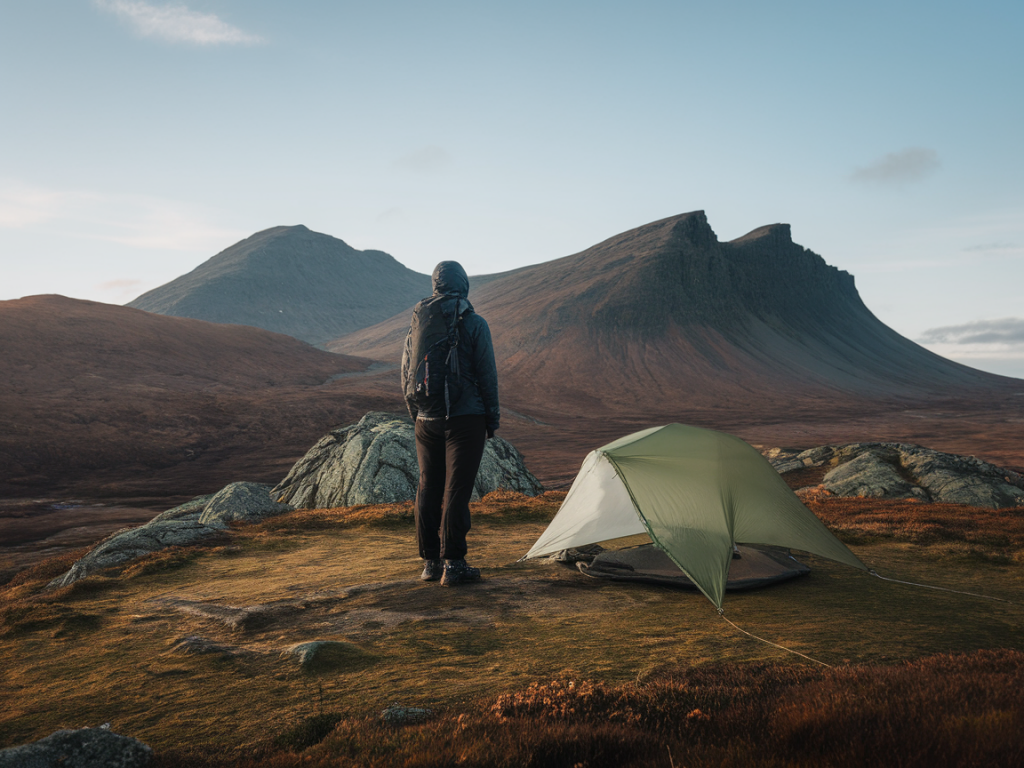
For me, a lightweight 1–2 person tent is the go-to when the forecast is uncertain and I want to be comfortable: space to change, stash wet kit, and cook out of the wind. Brands I’ve trusted include Vango (for durable, budget-friendly models), MSR (for sturdiness in bad weather), and Zpacks or Hilleberg for ultralight, expedition-grade options.
Use a lightweight tent if:
- You expect heavy wind, prolonged rain, or cold temperatures.
- You value privacy, internal storage, and a stable sleeping environment.
- You’re carrying overnight gear (camera kit, food, extra clothing) that needs to stay dry.
Practical tips for tent use on Scottish hills:
- Choose a tent with a decent footprint and porches if you’ll be storing boots or cooking in the vestibule. Vestibules keep condensation and cooking smells outside the sleeping area.
- Always stake out or guy your tent against gusts — Scottish wind can flip an under-anchored tent in seconds. Use guy lines on all clip points, and add rock anchors if stakes won’t hold.
- Ventilation is key to reducing condensation. Crack vents and doorways slightly unless the rain is horizontal; even a small airflow prevents waking in a wet bag.
- Set up with a low profile to the wind and use features like storm flaps and a robust fly for added resilience.
Comparative snapshot
| Criteria | Tarp | Bivvy | Lightweight tent |
| Weight | Lowest | Very low | Highest (but still light in modern designs) |
| Speed to deploy | Moderate (needs rigging) | Fastest | Moderate |
| Protection from wind/rain | Moderate (depends on pitch) | High for person-only | High overall |
| Comfort & storage | Low | Low | High |
| Condensation | Lower if well-vented | High (problematic) | Moderate (manageable) |
Kit pairings that work
My reliable combinations for unexpected wild camps are built around a shelter plus insulation strategy:
- Tarp + lightweight synthetic sleeping bag (e.g., Mountain Hardwear, Rab synthetic options) + insulated mat (Therm-a-Rest NeoAir). The mat keeps you off the cold ground and reduces condensation risks.
- Bivvy + down bag with a waterproof shell (or a down bag plus pertex shield) + closed-cell foam mat. This combo is minimal and lifesaving in a blowy, wet situation.
- Lightweight tent + down bag + inflatable mat + small stove for hot food. The tent gives space to dry kit and recover.
Legalities, ethics and Leave No Trace
Wild camping in Scotland is generally permitted under the Scottish Outdoor Access Code, but it comes with responsibilities: camp away from buildings and roads, stay no longer than necessary, avoid sensitive ground (peat bogs, fragile vegetation), and always pack out litter. If you’ve left a tarp or pegs, remove everything before you go. When using a bivvy, be discreet and avoid areas where people may be disturbed. I always try to leave a site in better condition than I found it — picking up other people’s rubbish and avoiding damaging vegetation with pegs or repeated pitches.
Choosing between tarp, bivvy and tent comes down to forecast, skill and personal comfort. Each shelter has a place in my pack depending on the objective. My advice: practice pitching in your local park in wind and wet conditions, know how your gear behaves, and prioritise a good sleeping mat and a warm bag — shelter does half the job, insulation does the rest.