I have learned that a strong wildlife record does not need a big camera bag or a perfect day. On a local trail, a smartphone, a clear habit of note-taking, and a little discipline can create records that are genuinely useful later. I use this approach whenever I walk somewhere familiar, because familiar places can still surprise me: a fox crossing a path at dawn, a migrant bird in scrub, a butterfly using a warm bank, or a fresh set of tracks after rain. A good record is not just a memory aid. It becomes a small piece of evidence that can help with identification, patterns, and seasonal change.
My aim is simple. I want a record I can trust a week later, a month later, and sometimes years later. I want to know where I saw something, when I saw it, what it was doing, what it looked like, and what made me think it was that species. When I keep that habit steady, my walks become more valuable without becoming complicated. I do not need a full survey kit for every outing. I only need a clear process and enough attention to capture what matters.
Start With A Repeatable Routine
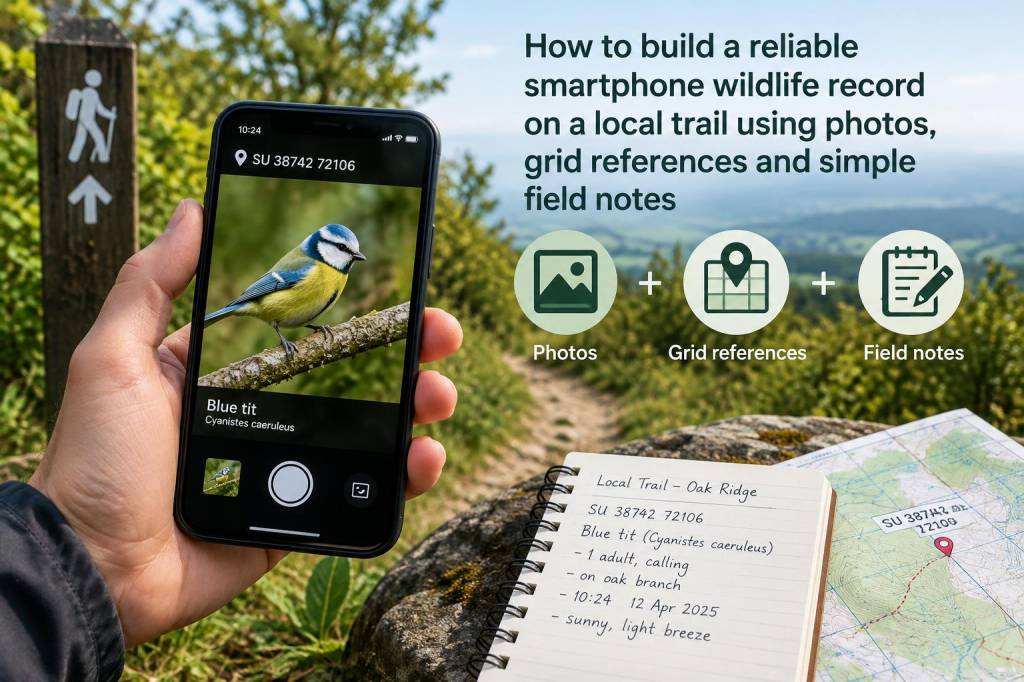
When I leave home, I already know that I will be collecting three things if wildlife appears: a photo, a location reference, and a short field note. That simple trio has saved me from many vague memories. A photo shows shape, colour, posture, habitat, and sometimes behaviour. A grid reference or map pin anchors the sighting in space. A field note captures details that a photo may miss, such as call, movement, weather, light, or nearby species.
I like to make this routine automatic. If I see something interesting, I stop, breathe, and do the same sequence every time: I take a few photos first, I save my location, and I write a few words while the scene is still fresh. That order matters to me because memory fades quickly once I start walking again. If I delay note-taking, I often lose the exact angle of the bird, the colour of the flowers around an insect, or the sense of scale in the scene.
Use Your Phone Camera As A Field Tool
A smartphone camera is more useful than many people think. I do not expect it to replace a proper camera for every situation, but it is excellent for records. I use the phone as a practical field tool, not just as a way to take pretty pictures. I often shoot more than one image of the same subject: a wide shot for habitat, a medium shot for posture, and a closer image for markings. If the animal or plant moves very quickly, I take a burst of frames and sort them later.
For records, sharpness matters more than style. I would rather have a plain but clear image than an artistic blur. I try to include something that helps with scale when possible: a leaf, a fence post, a path edge, or the surrounding vegetation. If I am photographing a bird, I look for angle, eye line, wing pattern, tail shape, and leg colour. If I am photographing an insect or plant, I focus on key features and avoid cropping so tightly that I lose context.
I also keep my lens clean. That sounds basic, but a dirty phone lens can ruin fine detail and create confusion later. A quick wipe on a soft cloth makes a real difference, especially in damp or dusty weather. On bright days, I shield the screen with my hand so I can see what I am doing and avoid overexposed frames.
Record Location With Enough Precision
Location is one of the most valuable parts of a wildlife record, and it is also one of the easiest to lose. I do not rely on memory alone. If signal is available, I use a map app to drop a pin. If I am somewhere with poor reception, I note a grid reference from an offline map or write down the nearest named feature, such as a bridge, gate, pond, stile, woodland edge, or path junction.
I have found that a good location note is specific enough to find again, but not so complicated that it slows me down. A record such as “east side of the path near the small marsh beside Old Mill Lane” is useful, but “about 150 metres past the second gate on the north-facing bank, near the stream bend” is even better if I want to revisit. For more structured records, I use Ordnance Survey mapping and save a pin in a mapping app, then copy the grid reference into my notes.
If I am recording a species for conservation or citizen science use, I always prefer precision. A grid reference can make a casual sighting far more useful to local recorders than a vague note like “seen near the woods.” That level of care helps with distribution records, seasonal monitoring, and habitat planning.
Write Field Notes While Memory Is Fresh
My field notes are short, but they are specific. I do not try to write a full diary on the trail. I only record what I might forget. A note can be as brief as: “male stonechat on bramble edge, singing, sunny exposed bank, west-facing slope, light wind.” That single line already captures species, sex if known, behaviour, habitat, weather, and aspect.
When I am unsure of an identification, I say so in the note. I might write “probable,” “possible,” or “not confirmed.” That honesty is important. It stops me from pretending certainty where there is none. Later, when I review the photos at home, I can test my initial idea against field marks and compare with similar species. A cautious note is often more useful than a confident mistake.
I also like to note anything that influenced my view. Was the bird backlit? Was the animal distant? Was the insect partly hidden in grass? Did rain blur the markings? These details help me judge the quality of the record later. They also remind me not to overstate what I saw.
What I Write In A Good Trail Record
Over time, I have settled into a simple structure that works well for me. It keeps records consistent without feeling rigid.
| Field | What I note |
|---|---|
| Date and time | Exact or approximate time, plus season if useful |
| Location | Grid reference, map pin, or named feature |
| Species | Confirmed name or cautious possible identification |
| Count | One, a pair, a small flock, or approximate number |
| Behaviour | Feeding, singing, flying, basking, hunting, resting |
| Habitat | Hedgerow, heath, wet meadow, streamside, woodland edge |
| Conditions | Light, wind, rain, temperature, visibility |
| Evidence | Photo, audio note, sketch, or brief physical sign |
Make Identification Easier Later
One reason I value photos and notes together is that each one covers gaps in the other. A photo may reveal plumage detail, but the note may record a call or behaviour that unlocks the ID. A note may say “small brown warbler in low willow,” while the photo later shows a pale eye stripe and wing bar. Together they form a stronger record than either source alone.
I also try to photograph surrounding clues. Habitat can be a major part of identification. A species that seems confusing in isolation may become obvious when I remember it was in a reed bed, on a dry heather slope, or beside a tidal margin. I once spent far too long puzzling over a record until I checked my notes and realised I had written “feeding on alder catkins beside ditch.” That simple habitat detail narrowed the options quickly.
When I am still uncertain, I compare my image with reliable field references later, and I check whether the note supports the possibility. I never rush to force a record into certainty. It is better to leave something unresolved than to create a false record.
Protect Accuracy While Staying Low Impact
A useful record should never come at the expense of the wildlife itself. I keep a respectful distance, avoid trampling sensitive vegetation, and move on if an animal shows stress. If I am watching nesting birds, roosting animals, or any species that seems particularly vulnerable, I do not linger just to improve the photograph. The record matters, but wellbeing matters more.
I also avoid repeated disturbance. If I need several photos, I take them efficiently and leave. On quiet trails, I try to be aware of my own noise, my silhouette, and my shadow. A calm approach often gives better results anyway. Wildlife usually behaves more naturally when I do not crowd it.
Another habit I value is not sharing exact sensitive locations publicly when that could cause harm. A record can be useful for conservation without becoming an invitation for pressure on a fragile site. I think carefully before posting details of rare or vulnerable species, especially if the place is small, accessible, or already under strain.
Review Notes Soon After The Walk
My records become stronger when I review them soon after I get home. I back up the photos, rename or tag them, and add any extra detail while the walk is still fresh in my mind. This is when I sort confirmed identifications from uncertain ones, and when I fill in missing pieces such as weather, exact route section, or a better location description.
I also like to compare several records from the same place over time. Patterns begin to appear. Certain birds return after a cold snap. Some insects appear on the same sunny bank each year. A fox track line crosses the same muddy stretch after rain. When those patterns build up, a local trail stops being just a route and becomes a living record of seasonal change.
For me, that is the real value of a smartphone wildlife record. It is not about collecting pictures for their own sake. It is about building a reliable memory bank that is useful, honest, and easy to revisit. A phone, a map pin, and a few disciplined notes can turn an ordinary walk into a meaningful record of what lives along the trail, when it appears, and how it uses the landscape.