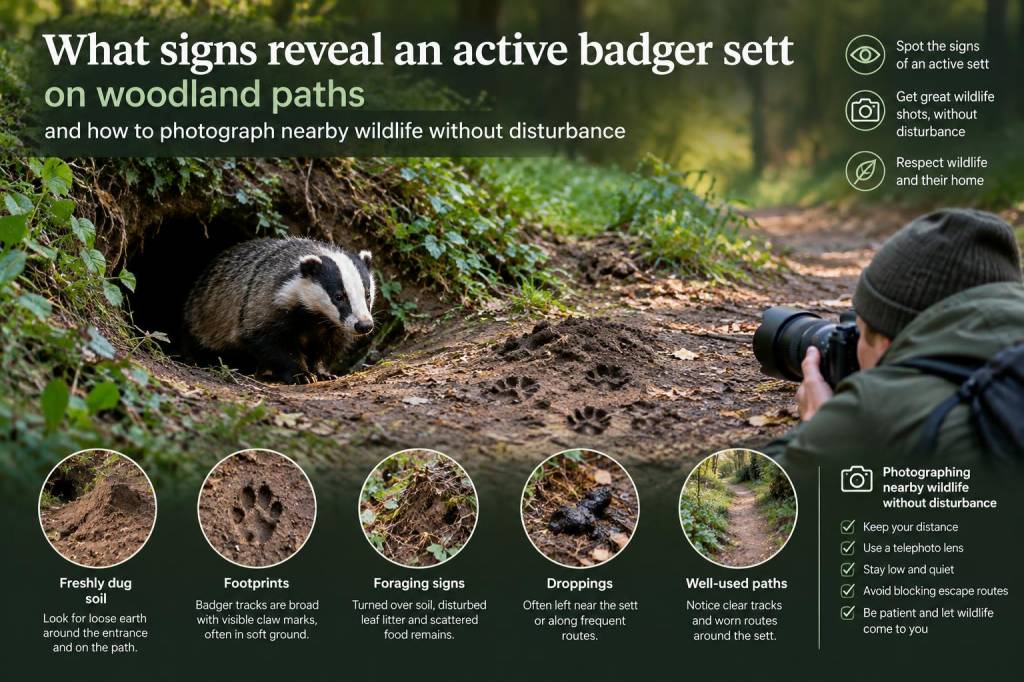
Woodland paths often give away more than people notice. When I walk quiet edges of mixed woodland, I pay close attention to low mud banks, worn side tracks, and small openings beneath roots, because an active badger sett leaves a pattern of signs that becomes fairly easy to read once you know what to look for. I do not rely on a single clue. I look for several signs together, then I slow down, keep my distance, and watch for wildlife activity without changing the way the animals behave.
Badgers are creatures of habit, and that habit shows in the landscape. A sett is not just a hole in the ground. It is a living network of entrances, spoil heaps, paths, scent marks, and repeated movement. On woodland walks I often find that one small patch of earth can reveal a whole hidden world if I pause long enough to study it properly.
Signs I look for first
The clearest sign is often a set of well-used entrances. These are usually oval or rounded openings set into a bank, hedgerow base, ditch side, or woodland rise. A quiet sett may have only a few visible entrances, but an active one often has several. Some may be obvious, while others are partly hidden by bracken, brambles, ivy, leaf litter, or fallen branches. I look for entrances that appear cleanly worn, with soil edges that look fresh rather than collapsed or heavily overgrown.
Fresh spoil is another strong clue. Badgers dig out material and leave small mounds of loose earth close to the entrance. This spoil often looks pale and recently turned compared with the surrounding ground. If rain has not yet softened it, the soil can still look crumbly and sharp-edged. I also watch for footprints in that loose earth. Badger prints are broad and distinctive, with long claw marks and a planted look that can appear almost hand-like in soft mud.
Then I check the paths leading away from the sett. Badgers are regular commuters, and they create narrow, low routes through grass, leaf litter, and undergrowth. These paths are often pressed flat, sometimes with a gentle shine where repeated use has polished wet vegetation or mud. If a path disappears under a fence line, along a hedge, or into a streamside corridor, I treat that as a sign of an established route rather than a random animal track.
Fresh activity versus old use
Not every sett entrance means current activity. Some setts are disused, and some are only used occasionally. What I try to judge is freshness. Fresh diggings, recently opened soil, scattered leaves pushed aside by movement, and clean claw marks all suggest recent occupation. A strong smell can also be present near an active sett, especially in warmer weather or after a period of use. I do not depend on scent alone, but it can be part of the picture.
I also look for bedding material. Sometimes grass, bracken, or dry leaves are pulled out of the sett entrance and left nearby. This can be a subtle sign, but it often appears around active or regularly maintained burrows. If I see old, collapsed entrances with no fresh spoil, no tracks, and heavy vegetation growth across the opening, I assume the sett may be inactive unless other signs point otherwise.
One thing I have learned is that woodland lighting can fool you. Damp shade can make old soil look fresh, and a dry entrance can look active simply because it is clear of leaves. I try to combine visual clues rather than making a quick judgement from one detail. Badger activity is a pattern, not a single mark.
Where I tend to find them on woodland paths
I most often find active setts where a woodland path meets a bank, ditch, or rough edge habitat. Badgers like cover, drainage, and easy access to surrounding feeding areas. That means I look near:
- Woodland banks with deep soil
- Hedgerow bases beside paths
- Streamside slopes with stable ground
- Old earthworks and embankments
- Quiet corners where bracken and scrub meet open ground
On mixed woodland walks, I have noticed that active setts often sit close enough to paths to be found, but not so exposed that the animals lose cover. A good sett location usually offers shade, some drainage, and nearby feeding routes through pasture, rides, or edge habitat. If there is a muddy squeeze point where animals cross a path, I pay extra attention there because repeated movement often leaves the clearest evidence.
What I photograph and what I avoid
When I photograph near a sett, I keep the camera work subtle and respectful. I want images that show the habitat, the signs, and, if I am fortunate, the wildlife itself, but I never want to pressure an animal into changing behaviour. For me, the most important rule is simple: if my presence changes the scene, I am too close.
I often begin with habitat images rather than animal images. A clean frame of the sett entrance, the surrounding bank, the low path, or the spoil heap can tell a strong story without disturbing anything. If I find badger tracks in mud, I photograph those too. They can be compelling when shot close to ground level, especially with soft side light that reveals texture.
If I do see wildlife nearby, I stay still and work slowly. I use a telephoto lens when possible, and I avoid moving closer just to fill the frame. I prefer to let the badger or other animal choose the distance. In low light I may raise ISO rather than step in. I would rather accept grain in an image than stress an animal for a cleaner frame.
I also avoid flash near setts. A sudden burst of light can be intrusive, and in a dark woodland it can change behaviour quickly. Natural light is usually enough if I am patient. If conditions are poor, I move on and return another day rather than trying to force a shot.
My field routine for quiet observation
When I think I am near an active sett, I slow my pace well before I arrive. I stop talking if I am with someone else. I look and listen from a distance first. Badgers can be active at dawn, dusk, and sometimes later in the evening, but a woodland can feel silent even when animals are nearby. I wait for movement, rustling, or a sudden change in birdsong, because other species often react before I spot the animal itself.
I try to stay downwind when possible. I also avoid standing directly in front of entrances. A side angle is usually less intrusive and gives me a better sense of depth and structure. If the ground is muddy, I choose a stable position rather than wandering around the entrance area and leaving extra footprints that could confuse my reading of the site.
My kit stays simple. A camera with a silent shutter mode, a small tripod or monopod, and a lens that gives me reach without heavy movement is usually enough. I keep clothing quiet and neutral, and I avoid shiny straps or noisy zips. Even a small sound can carry surprisingly far in still woodland.
Other wildlife that may share the area
Active badger setts often sit in lively wildlife corridors. I have seen foxes, deer, wood mice, robins, wrens, and even woodland birds using the same general area. That does not mean they all interact directly with badgers, but the habitat often supports a whole chain of activity. If I am patient, I may get a second subject without moving from the first observation point.
Sometimes I photograph the indirect signs instead of the animal. A deer track crossing a badger trail, a bird using the sett bank as a perch, or a wet print line leading into cover can be just as useful for storytelling. Those little details help show that a sett is part of a wider living system, not an isolated hole in the ground.
Reading the ground without getting too close
The ground around a sett can tell me a lot. I watch for flattened grass, scuffed soil, overturned leaf litter, and narrow runways through the undergrowth. I also check for latrine areas, which are often a strong sign of badger presence. Badgers use specific spots for droppings, and those places can appear as shallow pits or well-used patches nearby. I do not disturb them, but I do note their position because they confirm regular use.
Rain can help reveal signs. Wet ground holds prints better, and muddy margins around entrances can show fresh movement clearly. After rain, I like to revisit an area early, when signs are still crisp and before other walkers muddy the pattern. Winter can also make setts easier to read because fallen leaves expose the shape of the bank and the line of the paths.
Field notes I keep for myself
| Sign | What I notice | What it suggests |
|---|---|---|
| Clean entrance edges | Fresh soil, open hole, little collapse | Recent use |
| Spoil heap | Loose pale soil beside entrance | Active digging or maintenance |
| Paths | Flat, narrow routes through cover | Repeated travel |
| Footprints | Broad prints with claw marks in mud | Recent passage |
| Vegetation change | Leaves pushed aside, grass worn down | Ongoing movement |
| Bedding signs | Grass or leaves dragged out | Occupied sett |
These notes help me avoid guesswork. If I see several signs together, I treat the sett as active and adjust my behaviour accordingly. If I see only one weak clue, I keep my expectations low and keep moving carefully.
Respectful photography near wildlife edges
My approach is always shaped by restraint. I do not bait animals, I do not block access routes, and I do not linger if an animal appears uneasy. The strongest wildlife images often come from patience, not pursuit. I watch for natural movement, wait for a clean moment, and let the scene happen on its own terms.
Sometimes I come away with no animal image at all, only tracks, entrances, and a few quiet frames of woodland texture. I am fine with that. A good wildlife photograph is not only about seeing the animal. It is also about showing the place honestly, without pressure, and leaving enough space for the next visitor to experience it naturally.