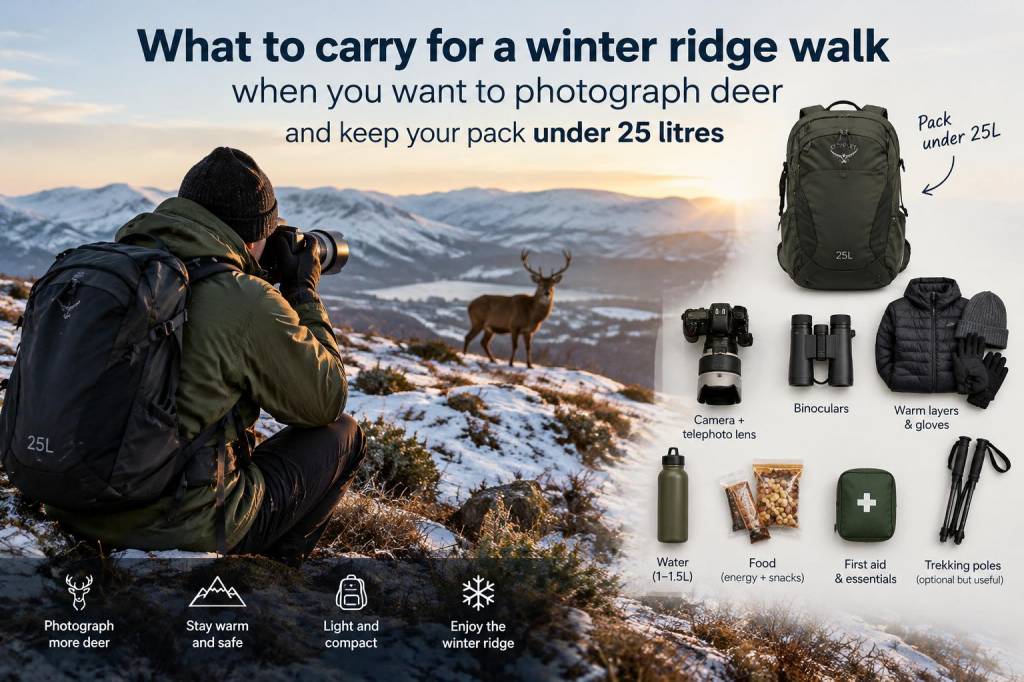
When I head out for a winter ridge walk with a camera in my pack, I try to make every item earn its place. A small pack changes everything: it keeps me moving lightly, reduces faff when I need to react quickly to wildlife, and stops me from carrying so much that I feel sluggish on steep ground. If I am hoping to photograph deer, I need enough warmth and safety gear to stay out for hours, but I also need space discipline. For me, staying under 25 litres is not a challenge to “go minimal” for its own sake; it is a way to stay mobile, quiet, and ready for changing weather.
Winter ridge days ask for a careful balance. I want insulation for pauses, waterproofing for sudden sleet, food and water that will not freeze too quickly, and a camera setup that is ready the moment a deer appears over a crest or in a frosty hollow. I also want to avoid overpacking, because every extra layer, accessory, and lens adds weight and slows decision-making. Over time I have learned that the right kit is less about carrying more and more about carrying what matches the day.
What I value most in a small winter pack
My first question is always simple: what must I have if the weather turns ugly, I get delayed, or I end up waiting motionless for wildlife? That answer shapes everything else. On a winter ridge, I prioritise warmth, wind protection, dry hands, navigation, food, and a camera system that works without constant swapping.
For deer photography, I usually want a lens that gives reach without forcing me into a giant bag. A lightweight telephoto zoom is often my favourite choice because it covers enough distance for cautious subjects and still lets me respond if the scene changes. I would rather carry one flexible lens than a heavier pair that eats volume and creates more lens changes in cold air.
I also think about access. If I cannot reach a layer, glove, snack, or camera quickly, then I am more likely to miss a shot or get chilled while rummaging. A compact pack should feel organised rather than crammed. I like using small internal pouches or simple packing cubes so I know exactly where each item lives.
My core clothing choices
Winter ridges can feel mild at the start and bitter once the wind gets through. I dress in a way that lets me regulate temperature while walking uphill, then trap heat when I stop to watch deer or take photographs. My system usually starts with a wicking base layer, a breathable mid layer, a warm insulation piece, and a shell that can handle wind and wet weather.
I prefer a lightweight synthetic or merino base layer because I often work up a sweat on the climb. A fleece or thin active mid layer gives me enough warmth while staying easy to pack. For insulation, I usually bring a compact synthetic jacket or a light down jacket, depending on forecast and dampness. If I expect persistent wet weather, synthetic insulation feels safer. If the day looks cold and mostly dry, down gives excellent warmth for its weight.
My shell jacket matters a lot. On exposed ridges, wind is often the real enemy, not rain. A reliable waterproof and windproof shell with a hood can save the day when conditions shift. I also like trousers that dry quickly and do not feel restrictive on steep ground. If snow is present, I may add gaiters, especially if I know I will be crossing drifts or wet heather.
Camera kit that stays compact
When I am trying to keep a pack under 25 litres, camera discipline matters just as much as clothing discipline. I do not want to carry a bulky body with multiple lenses unless I know I will need them. For most winter deer walks, I aim for a simple and versatile setup.
A mirrorless body is often my pick because it saves space and weight. Paired with one telephoto zoom, it can handle both distant deer and wider landscape scenes. I like having a lens that starts reasonably wide and reaches far enough for wildlife without forcing me to crop everything later. If I expect close encounters in woodland edges or mixed scenery, a second compact prime can be useful, but only if I know I will actually use it.
I carry one spare battery in an inner pocket so it stays warm. Cold weather drains power faster than people expect, and a dead battery can end a promising encounter just as the light improves. I also bring a small microfibre cloth, because condensation, drizzle, and blowing moisture are common on exposed ground. If I am likely to kneel in wet grass or snowy heather, I may pack a lightweight waterproof camera cover or at least a dry bag that protects the body during travel.
Food, water, and what I actually eat
On a winter ridge, I do not want elaborate food. I want something I can eat without much thought, even if my hands are cold. A compact snack system works well: flapjack, nuts, a sandwich, energy bars, and perhaps a savoury option for variety. I usually split food into easy-access portions so I can eat while walking or during a short stop without unpacking everything.
Water deserves more attention than it sometimes gets. In very cold weather, I keep a bottle inside the pack rather than on the outside, and I use an insulated bottle sleeve if conditions are harsh. I do not always carry a full litre if the route is short and I know there are easy refill points, but I never assume I will find drinkable water on the ridge itself. Hydration affects concentration, balance, and patience, all of which matter when I am trying to photograph deer in wind and low light.
Safety items I never leave behind
Small packs can become dangerous if they encourage me to leave out essentials. I always carry a map, compass, and a reliable way to navigate even if my phone dies. On a winter ridge, visibility can change quickly, and deer stalking ground often has subtle paths and poor landmarks. I trust my phone for backup, not as my only tool.
My safety list is simple but non-negotiable:
- Map and compass
- Fully charged phone in a warm pocket
- Head torch with spare battery or backup light
- Small first aid kit
- Emergency bivvy or survival bag
- Whistle
- Personal locator device if the route is remote
I do not want these items rattling around loose in the pack. I keep them in a dedicated pouch so I can reach them fast if I need them. The emergency bivvy is especially important on winter days, because even a short stop can become uncomfortable if I am injured, exhausted, or forced to wait for help.
Gloves, hat, and the problem of cold fingers
If I could give one piece of practical advice for winter wildlife photography, it would be this: sort out your hands. Cold fingers ruin photo sessions more quickly than almost anything else. I usually carry a thin liner glove for shooting, plus a warmer over-glove or insulated mitt for pauses. That way I can expose my fingers just long enough to work the camera, then put warmth back on immediately.
A warm hat or beanie is equally important. I lose a surprising amount of heat through my head when I stop moving, especially if the wind is strong. A neck warmer or buff adds versatility too. It can protect my face during biting gusts, sit under a hat, or come up over my ears if I am waiting in one place for deer movement.
I also like hand warmers on very cold days, though I do not always need them. They are useful when I know I will be standing still for long periods. If I use them, I place one in a pocket where my spare battery lives, not next to the camera body itself, so I keep power warm without risking discomfort or unnecessary bulk.
How I organise a pack under 25 litres
Organisation is what makes a small pack feel generous. If I just throw things in, the pack becomes awkward fast. If I pack with intent, I can fit a full winter system in a surprisingly small space.
| Item | My usual choice | Reason |
|---|---|---|
| Pack | 20 to 25 litre day pack | Enough room for layers, food, and camera kit without excess bulk |
| Camera | Compact mirrorless body | Good image quality with less weight than a larger setup |
| Lens | One telephoto zoom | Flexible for deer and landscape work |
| Insulation | Light synthetic or down jacket | Warmth for static moments |
| Shell | Windproof waterproof jacket | Protection from ridge weather |
| Hands | Liner gloves plus warm over-gloves | Better shooting control and warmth |
| Safety | Map, compass, torch, bivvy bag | Essential winter security |
I keep heavier items close to my back and midline so the pack carries well on uneven ground. Bulky but light items, such as insulation, can sit higher or lower depending on pack shape. Small items like snacks, gloves, and cloths go in outer pockets or top access if the pack has them. I avoid filling every spare space, because a little room helps me pack layers quickly after a stop.
What I leave behind
Learning what not to carry has been just as valuable as learning what to bring. I usually leave behind duplicate lenses, heavy tripods, unnecessary electronics, extra clothing “just in case” layers that overlap too much, and bulky food packaging. If I am honest, I also leave behind items I think I may want but rarely use on this kind of walk.
Tripods are a good example. I own them, and I use them when the conditions and subject demand it, but on a mobile winter ridge day they often become dead weight. If the light is low and I expect longer exposures, I may accept the extra bulk. But if deer movement is likely and I need to stay nimble, I would rather rely on stabilisation, good technique, and a steady stance.
I also avoid carrying too many “nice to have” photography extras. A small pack is not the place for every possible accessory. The goal is to stay ready, not to recreate a studio on a hilltop.
My final pack logic for deer and winter ridges
Before I leave home, I ask myself three questions: can I stay warm if I stop for an hour, can I navigate if visibility drops, and can I get the camera out quickly enough to respond to deer? If the answer to any of those is no, I adjust the pack rather than hoping for the best. That habit has saved me from many uncomfortable days.
For me, the sweet spot is a pack that feels almost spare when I first lift it, then proves itself over and over during the walk. I want it to hold a compact camera setup, weather protection, enough food and water, and the safety kit that keeps me calm when conditions change. When that balance works, I spend less time managing gear and more time reading the hill, watching movement in the distance, and waiting for the right moment to raise the camera.
What matters most is not filling 25 litres exactly. It is making every litre count, so I can walk lightly, shoot confidently, and remain comfortable enough to stay out longer when winter wildlife finally shows itself.