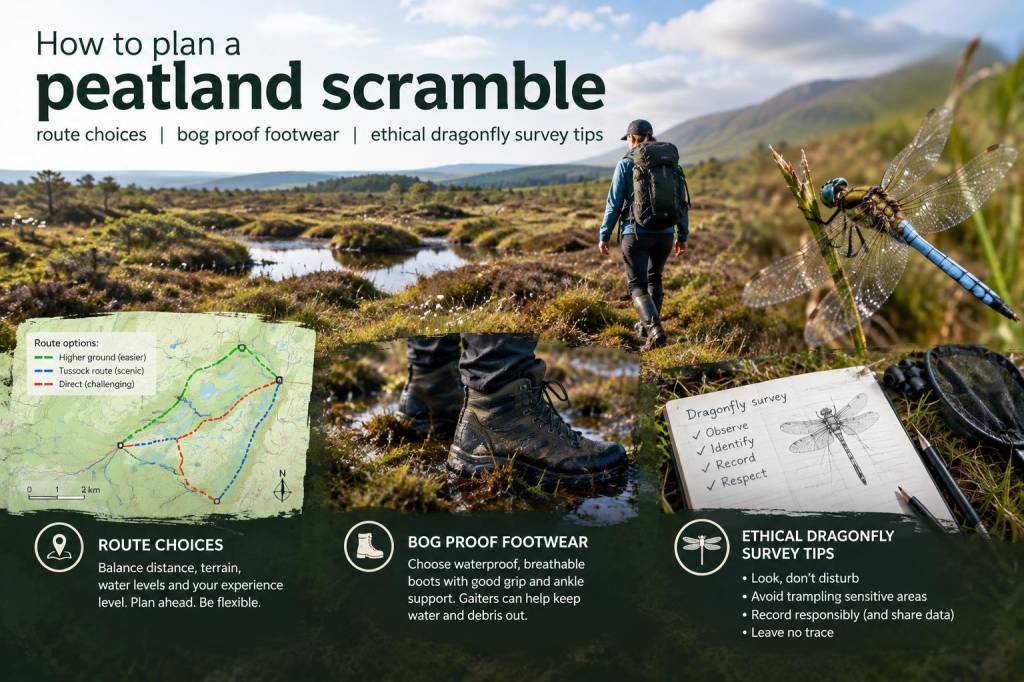
Peatland scrambles are a special kind of walk: soft, spongy terrain that can feel impossibly remote one minute and astonishingly alive the next. I’ve spent hundreds of hours wandering and scrambling across UK bogs and blanket bogs, and I still get a thrill when you surface onto a tussocky ridge or find a teeming dragonfly-filled pool. But peatland is fragile, wet underfoot, and full of hidden hazards. Here’s how I plan a peatland scramble—choosing routes, picking bog-proof footwear, and carrying out ethical dragonfly surveys without damaging habitat.
Choosing the route: read the land before you go
Not all peatlands are created equal. Some are heavily eroded, with deep gullies and bare peat; others are intact, with a carpet of sphagnum and hummocks that store water and carbon. When I plan a scramble I prioritise routes that match my skill level and conservation intent.
Key things I look for when plotting a route:
- Map and contours: I use Ordnance Survey maps (Explorer 1:25k) and OS Maps app to identify ridges, streams and potential gaps in peat. Contours help spot steep eroded gullies to avoid.
- Satellite imagery: Bing and Google satellite layers can show peat bog condition—pale, eroded areas often indicate bare peat or drains.
- Local knowledge: I check local walking forums, peat restoration group reports, and recent trip reports for current conditions (boardwalks, closed areas, active restoration).
- Season and weather: Late spring and summer bring dragonflies and easier surface drainage; autumn and winter make peat far wetter and more treacherous.
- Access and sensitivity: If an area is under active restoration—like heather burning prohibition zones or new damming works—I either avoid it or stick to established firm lines to minimise impact.
When possible I plan a loop that uses firmer features—old turf banks, stone walls, and grassy ridges—rather than crossing wide open, intact peat where footprints can damage vegetation. If I must cross vulnerable patches I try to stick to the highest and driest hummocks, and step lightly.
Bog-proof footwear and gaiters: what I wear and why
Over the years I’ve tried everything from lightweight trail shoes to full Wellingtons. For most peatland scrambles I favour a balance: waterproof, grippy, supportive and repairable. My current go-to is a mid-height waterproof boot with a sticky Vibram sole—for example, the Meindl Vakuum or Scarpa Zodiac models—but there are lots of good options from La Sportiva, Hanwags and Keen depending on foot shape.
Footwear features I prioritise:
- Waterproof membrane (Gore-Tex or equivalent): keeps feet dry when stepping into bog pools or wet tussocks.
- Good ankle support: reduces twisting risk on uneven hummocks and hidden holes.
- Aggressive tread: deep lugs and a sticky rubber compound help grip peat and wet grass.
- Durability and resolability: peat can abrade soles; boots that can be resoled save money and waste.
I always wear tall gaiters (e.g. Rab or Outdoor Research) to keep peat, sphagnum and water out of my boots. For lightweight summer scrambles in drier peat I sometimes use waterproof trail shoes plus gaiters, but I’ll swap to boots if I’m crossing deep bog or expect long wet sections.
Small extras that make a big difference:
- Foot powder or wool liners to manage moisture and reduce blisters.
- Spare laces and a mini repair kit in case of damage on remote routes.
- Walking poles with carbide tips: essential for testing hummocks ahead and balancing on tussocky ground.
Route tactics on the peat: move light, move wisely
On peat I think in terms of surface stability: hummock, hollow, pool. Hummocks (raised clumps) are generally safer; pools and hollows hide saturated peat and sometimes deep holes. My tactics:
- Probe first: I use my pole to test each step on unfamiliar hummocks, especially those covered in grass or moss.
- Step short: Short steps keep your centre of gravity stable and reduce the chance of punching through a crust.
- Spread the load: If carrying heavy kit, I tighten my rucksack straps so weight is close to my back—this reduces sinking.
- Avoid drains and gullies: Erosion channels can collapse and are often connected to deeper bare peat.
- Follow firm features: Old turf banks, stone walls, and boardwalks are there for a reason—use them.
Ethical dragonfly surveying on peatlands
Dragonflies are one of my favourite reasons to spend time on peatland pools. They’re charismatic, relatively easy to observe, and act as indicators of healthy wetland. But ponds and bog-margins are sensitive. Here’s how I survey without harming the habitat.
Before you go:
- Know the local species: Use atlases or apps (iRecord, iNaturalist) to know which species to expect and which sites are priority for protection.
- Survey permissions: If the peatland is on private land or a designated reserve, check access rules and any survey restrictions.
- Timing: Dragonflies are most active on warm, calm days. Late morning to mid-afternoon in summer is usually best.
At the pond:
- Keep to firm ground: Avoid trampling marginal vegetation and sphagnum banks where larvae develop.
- Use binoculars and a camera: I rely on a 300mm lens for close photos rather than catching dragonflies. Telephoto images are often sufficient for ID and avoid handling.
- Minimise disturbance: Approach slowly and stay downwind of the bank if possible. Sudden movements send adults away and can disturb ovipositing females.
- No netting unless trained: Catching requires skill and often permits; if you must net, use proper technique and return individuals immediately to the same spot.
- Record details: Note time, weather, microhabitat (open water, floating vegetation, bog-margins) and behaviour—these data help conservationists.
Gear checklist (compact table)
| Essential | Why |
| Mid-height waterproof boots | Support, grip, waterproofing |
| Tall gaiters | Keep peat and water out of boots |
| Walking poles | Probe ground and balance |
| Waterproof map/app + compass | Navigation where tracks are absent |
| Camera with telephoto / binoculars | Dragonfly ID without handling |
| Micro repair kit & spare laces | Repair in remote areas |
Leave no trace—and help peat recover
Peatlands are major carbon stores and biodiversity hotspots. My ethic is simple: leave it better than I found it. That means sticking to durable surfaces where possible, not cutting peat or trampling restoration sites, and taking litter and micro-trash out with me.
If you’re motivated, you can do more—join local peatland restoration volunteering, report eroding drains to the landowner or conservation body, and submit dragonfly records to local recording schemes. Your observations help map hotspots and monitor recovery.
Peatland scrambles are an exercise in humility—every step matters. Plan routes that respect the land, choose footwear that keeps you safe and leaves the bog intact, and observe wildlife like dragonflies with the gentleness you’d want for your own home. The reward is real: quiet pools thick with life, expansive skies, and the knowledge you’ve experienced a rare and fragile ecosystem without breaking it.