When I head for a windy shoreline, I want a tripod that supports a camera without turning my walk into a chore. Coastal photography asks for a strange balance: enough stability to hold a frame steady in gusts, but not so much bulk that I dread carrying it across dunes, rocks, and long clifftop paths. I have learned, often the hard way, that a tripod can make or break a day on the coast. A brilliant camera is no use if I leave the support in the car because it feels too heavy, too awkward, or too fussy to set up in a hurry.
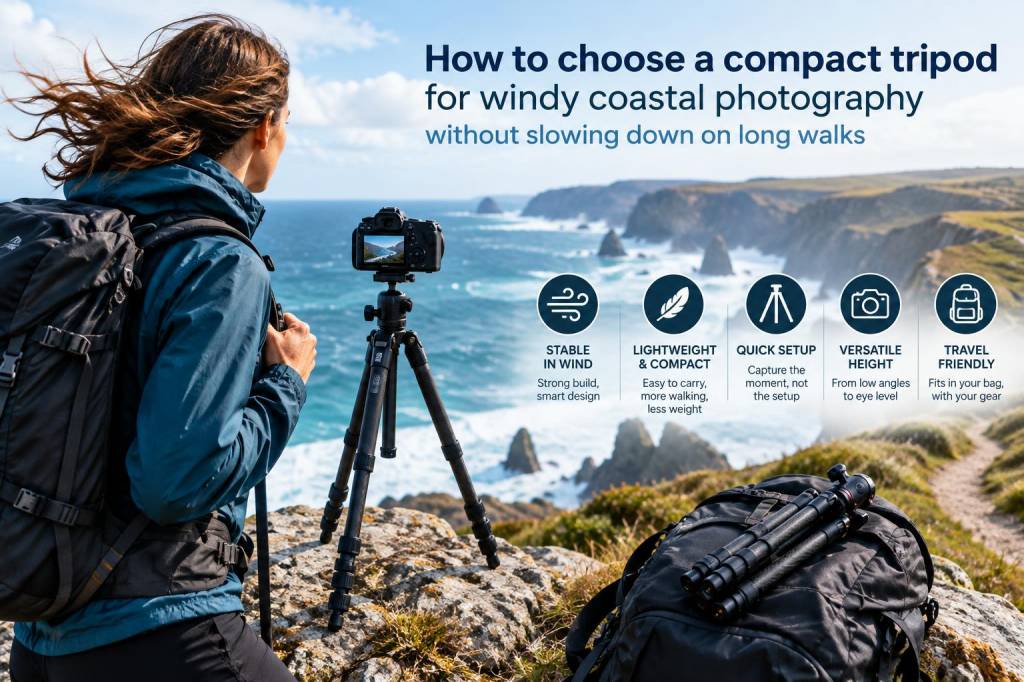
My first filter is simple: a tripod must earn its place in my pack. If I am covering several miles with a camera, extra lens, water, layers, and food, every gram starts to matter. I look for a model that folds small enough to live on the outside of my bag without catching on branches or swinging wildly from side to side. I also want a setup that opens quickly, because coastal light changes fast and wind often gives only brief moments when a frame is usable. If I spend five minutes wrestling with legs and locks, I can lose the scene entirely.
What matters most on exposed coastlines
In windy places, stability starts with mass distribution rather than sheer weight alone. A tripod that feels solid in a shop may still fail outside if its centre column is raised too high or if the leg sections are too thin and flex easily. I prefer a design that lets me keep the centre column down as much as possible. That single habit often improves stability more than buying a heavier model. On a cliff edge or a beach with strong crosswind, I want my camera sitting low and firm, not perched high above the tripod’s core.
Leg lock design matters more than many buyers expect. I have used twist locks and lever locks in different conditions, and each can work well if built properly. Twist locks often feel sleeker and are easier to clean after salt spray, sand, and grit, which makes them appealing for coastal work. Lever locks can be quicker for fast deployment, but I always check whether they are bulky when packed and whether they snag when I sling the tripod on a shoulder strap. For me, speed matters, but not at the expense of reliability.
Foot design also deserves attention. On wet rock, firm sand, mud, or shingle, I want feet that grip without slipping. Some tripods come with removable rubber feet, metal spikes, or both. I like having options. Rubber feet are kinder on hard surfaces and feel less alarming on smooth stone, while spikes help when the ground is soft or uneven. If I know I will be shooting from exposed headlands, I want a tripod that can dig in a little, especially when gusts come in bursts rather than a steady stream.
Choosing a compact tripod without choosing the wrong compromise
Compact tripods can be brilliant, but many are compact because they are built with smaller leg tubes, lower load ratings, or shorter working heights. That does not automatically make them poor choices. I have used very small carbon models that were excellent for travel and coastal walks because they were engineered intelligently. The key is to understand what you are giving up. A tiny folded size is useful, but if the tripod becomes twitchy in wind or leaves me crouching in wet grass for every frame, I stop enjoying the session.
I look closely at three things before deciding:
- Folded length, so I know whether it fits my bag or straps securely outside it
- Working height, so I can compose comfortably without constantly bending over
- Load capacity and real stiffness, so I know whether it can handle my camera and lens in gusts
Manufacturers often advertise a load rating that sounds generous, but I treat that number as a rough ceiling rather than a promise of performance. A tripod may technically support a certain weight while still vibrating too much for long exposures or telephoto work. When I photograph seascapes, rock stacks, or birds along the shore, I want my support to feel calm, not merely “strong enough” on paper.
Carbon fibre is usually my first choice for long coastal walks because it keeps weight down and tends to dampen vibration better than aluminium. That said, I do not dismiss aluminium outright. A well-made aluminium tripod can be excellent if the budget is tighter or if I want a kit I do not worry about quite so much around salt, sand, and knocks. The trade-off is usually weight, so I ask myself an honest question: will I carry it willingly after six miles into a headwind?
Why leg design changes the whole experience
Leg section count has a direct effect on convenience and stability. More sections usually mean a shorter folded length, which sounds ideal for walking, but it can also mean more joints and slightly less rigidity. I tend to prefer the simplest design that still packs well enough for my route. If a tripod folds small enough with three leg sections instead of four, I often choose the three-section version because it usually feels steadier and faster to use. That small difference can matter a lot when I am setting up repeatedly while moving along a coastline.
Leg angle selectors are another feature I value. Being able to spread the legs wide helps on uneven rock, low viewpoints, or soft ground where I need a broad stance. I also like tripods that let me set one leg lower than the others to cope with sloping terrain. Coastal paths are rarely level, and I find that flexibility more useful than extra decorative features.
If a tripod has a hook under the centre column, I do not ignore it. I rarely hang anything heavy that swings violently in wind, but a small camera bag or a water bottle placed carefully can sometimes help. Still, I do not rely on the hook as a magic fix. In strong gusts, I prefer good leg stance, low setup, and sensible positioning facing away from the worst of the wind. Hardware helps, but field habits matter just as much.
What I carry, and what I leave behind
For long walks, I try to avoid carrying a tripod that does too many jobs badly. A compact model should be compact first, practical second, and elegant third. I have seen tripods with built-in gimmicks that add bulk without improving real-world use. I would rather have a clean, dependable design with a good head than a feature-heavy item that slows me down.
My ideal coastal setup usually includes a ball head that locks firmly and adjusts smoothly with cold hands. I want controls I can operate without taking off gloves for long. A good ball head should hold position without sagging, especially with a camera pointing slightly upward toward a breaking wave, a lighthouse, or a bird in flight. I also prefer an Arca-type clamp because it makes mounting and removing the camera fast, which is useful when I need to move quickly between hand-held shooting and tripod work.
I often carry a small cloth for wiping salt spray and a brush for removing grit from leg locks. That may seem minor, but it protects the tripod and keeps it pleasant to use. Coastal environments are harsh on gear. Salt crystals can work into threads, sand can jam locks, and damp conditions can make everything feel sticky. A little routine care saves frustration later.
My practical checks before buying
Before I commit to a tripod, I imagine a real walk rather than a showroom moment. I picture carrying it for miles, stopping on a windy headland, unfolding it with cold fingers, and composing a frame while the light shifts. If a tripod feels awkward in that imagined scenario, I know it will frustrate me in reality. I also think about the camera body and lens I will use most often. A small mirrorless camera with a compact lens asks less from a tripod than a heavier body with a telephoto zoom.
| Feature | What I look for | Why it matters on the coast |
|---|---|---|
| Weight | Light enough for long carries | Encourages me to bring it on every walk |
| Folded length | Short enough for my pack or strap | Improves comfort and balance while walking |
| Leg rigidity | Minimal flex, strong locks | Reduces vibration in wind |
| Centre column | Can stay low or remain unused | Improves stability in gusts |
| Feet | Grip on rock, sand, and mud | Helps on uneven ground |
| Head | Smooth, secure, easy to adjust | Saves time when light and weather change quickly |
Price matters, but I try not to chase the cheapest option if it will frustrate me every time I use it. A tripod that feels awkward will stay at home, and that means I have spent money on gear that does not support my photography. At the same time, I do not assume the most expensive model is right for me. I want value, durability, and honest performance in conditions I actually face, not just in promotional images.
Field habits that make a small tripod feel steadier
Even a very compact tripod can perform far better when I use it well. I lower the centre of gravity by keeping the legs wide and the centre column down. I place one leg pointing toward the wind when possible so the camera has a more stable stance. I avoid extending the thinnest leg sections unless I really need the height. I also press the tripod feet gently into sand or soft ground so it settles before I attach the camera.
When I am shooting long exposures of waves, I keep my camera bag close by but not hanging from the tripod in a way that introduces sway. If the wind is fierce, I shelter myself or the camera behind rocks where safe to do so. I also pay attention to composition efficiency. I set up with intent, make a few strong frames, and move on rather than staying locked into one scene for too long. That approach suits long coastal walks better than standing in one place endlessly.
I have found that the right compact tripod makes me more adventurous. It lets me stop for a minute on a windswept path and know I can make a steady frame without regretting the weight I am carrying. That confidence changes the whole walk. Instead of treating the tripod as an extra burden, I see it as part of the rhythm of the day, ready to come out when the coast offers a fleeting moment worth keeping.