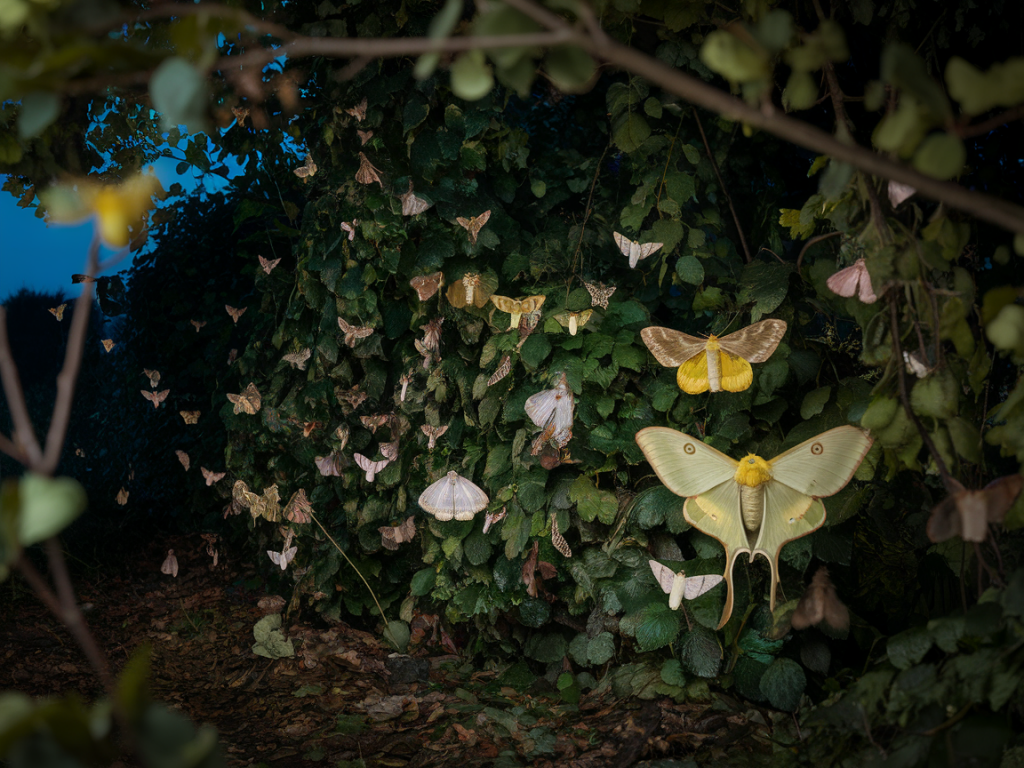
Running a hedgerow moth night in a village is one of the simplest and most rewarding ways to connect people with nocturnal wildlife. You don't need a garden full of professional kit or a heavy wallet — just a bit of planning, a white sheet, a light source, a camera (even a smartphone), and a willingness to learn. Below I walk through everything I do for community moth nights and how I then submit identifications to iRecord so records contribute to real science.
Why a hedgerow moth night?
Hedgerows are rich mosaics of food plants and microhabitats, attracting a wide range of moth species. In a small village setting you can record woodland-edge species, grassland feeders, and species associated with gardens. A moth night offers a great mix of accessibility and conservation value: most people are unfamiliar with moths, so it’s a wonderful way to share simple ID skills while generating useful records for local biodiversity mapping.
Permissions, timing and safety
First things first — check land access. If the hedge is on public footpath or common land you should be fine, but for private land get the landowner’s permission and agree on where people can stand and park. Plan events for warm, still evenings from late spring through early autumn. Peak months for species richness are May–September, and best nights are warm, humid and not too windy.
Safety notes I always share with attendees:
- Wear reflective clothing and bring a torch for moving between locations.
- Stay on paths and keep children within sight.
- Avoid bright white headlamps shining into others' eyes — use red filters or low settings.
- Respect neighbours: keep noise low and avoid shining lights into windows.
What kit you actually need (no specialist kit required)
You can run an effective event with entirely household items or cheap consumer kit:
- White sheet — a clean bedsheet stretched between two fence posts, temporary clothesline or between two trees. The white surface acts as a landing target for moths.
- Light source — many moth workers use UV or mercury lamps, but you can substitute with strong LED lamps, a bright battery lantern, or a desk lamp. UV torches (handheld) are inexpensive and useful for shining on nearby foliage.
- Smartphone or camera — for photos to submit to iRecord. Modern phones are excellent for most moths; a cheap macro lens clip can help for small species.
- Clips/tape and pegs — to secure the sheet and prevent it sagging.
- Fold-up stool and clipboard — for note-taking and comfort.
- Binoculars — optional but useful for watching hawk moths at flight.
Setting up your sheet and light
Stretch the sheet so it’s taut and vertical — this reduces creases where moths hide in shadows. Position the lamp so it shines evenly onto the sheet from about 1.5–3 metres away. If using a lantern, hang it centrally; desk lamps can be clamped to fence posts. If power is an issue, use battery lanterns or a shallow camping power bank with an LED lamp. Try to position the setup near the hedgerow so moths attracted to foliage will pass by the sheet.
If you’re concerned about neighbours, a lower-wattage setup at close range can still attract decent numbers — it’s the contrast that matters as much as absolute brightness.
Getting good photos for identification
Photographs make iRecord submissions far more valuable and allow experts to verify IDs. Tips I pass on:
- Photograph both dorsal (top) and ventral (underwing) views when possible — gently coaxing a moth to the edge of the sheet with a small soft paintbrush works well.
- Include scale — a leaf, ruler or a finger near (but not touching) the moth helps size estimation.
- Avoid harsh flash that blows out colour; use the phone’s HDR setting or a diffused torch for softer light.
- If a moth moves to a fence or leaf, photograph it there too — sometimes the natural posture shows key features.
- Take multiple frames; motion and slight angle changes often capture the identifier-critical features.
Ethics and handling
I don’t advocate killing or extensive handling. If you must handle a moth (e.g. to show it to a child), do so minimally and carefully:
- Handle by the thorax very gently — avoid touching the wings’ scales where possible.
- Work quickly and return the moth to where you found it.
- Use a small clear pot with air holes if you need to contain the moth briefly for a photo, then release.
Likely species in a hedgerow (quick ID starters)
Here are some common and easy-to-spot species you’ll often see in UK hedgerows:
| Common name | What to look for |
| Yellow Underwing | Plain brown forewings, flash of bright orange hindwings when flown |
| Large Yellow Underwing | Similar but larger; common in gardens/hedges |
| Oak Beauty | Speckled, camouflaged pattern on forewings near oak-lined hedges |
| Green Carpet | Small greenish moth; often on hedgerow leaves |
| Common Quaker | Small, grey/brown, variable; common in many habitats |
Using iRecord to submit your sightings
iRecord is straightforward and flexible. I use the iRecord app on my phone when I'm out, and sometimes upload a batch from the website later. Steps I follow:
- Create an iRecord account (if you don’t already have one). Use a local email so you can join local projects or validation groups later.
- Open the app and create a new record. Enter the date and time (the app usually auto-fills this).
- Tap the location pin to set the grid reference. For accuracy, use the map to drop the pin on the exact field/hedgerow; the app shows the OS grid reference.
- Select the species from the suggestions — if you’re unsure put the closest genus or mark it as “sp.” and upload photos. Don’t worry about being wrong; recorders and verifiers will help refine IDs.
- Attach your best photos. The more useful angles you include, the easier verification becomes.
- Add any comments — e.g. “on sheet at edge of hawthorn hedge, small group of 12 people, photographed under battery lantern.” Notes about microhabitat (e.g. hawthorn, bramble) are valuable.
- Submit and optionally flag the record for verification. Many county moth volunteers monitor iRecord and will confirm or correct IDs.
Organising the event and engaging people
I run a brief intro showing how to use the sheet and lamp, then teach simple ID tips (size, resting posture, distinctive marks). Encourage participants to photograph and upload via iRecord; for less confident users I upload photos myself and submit on their behalf, crediting them in the notes.
Make it social — hot drinks, a simple fold-out table with laminated quick ID sheets, and a “moth of the night” vote keeps people engaged. If you plan on doing regular sessions, create a small CSV of repeat records or a shared Google Drive folder for photos to make bulk uploads easier later.
After the event: verification and follow-up
Check your iRecord notifications — experts may ask for additional photos or clarification. I also export my records into a spreadsheet and map them to look for species hotspots. Sharing a short follow-up post on your community page with highlights and photos encourages repeat attendance and shows people their contribution matters.
Running a hedgerow moth night on a village scale is low-cost, low-impact and high-reward. With a white sheet, a lamp, a smartphone and iRecord you can generate useful biodiversity data while introducing people to a hidden and beautiful part of the night. If you’d like, I can share a printable A4 leaflet template and a short ID sheet you can hand out on the night.